What a $10m water bottling deal says about valuing a water cooler business
By Zenith Water Dispense Team ·
A Thai stock exchange filing has put a public price on a bottled water plant. The company was founded in December 2025. Charoen Pokphand Foods is paying THB 334.7 million for 51%, in two tranches that mean very different things.
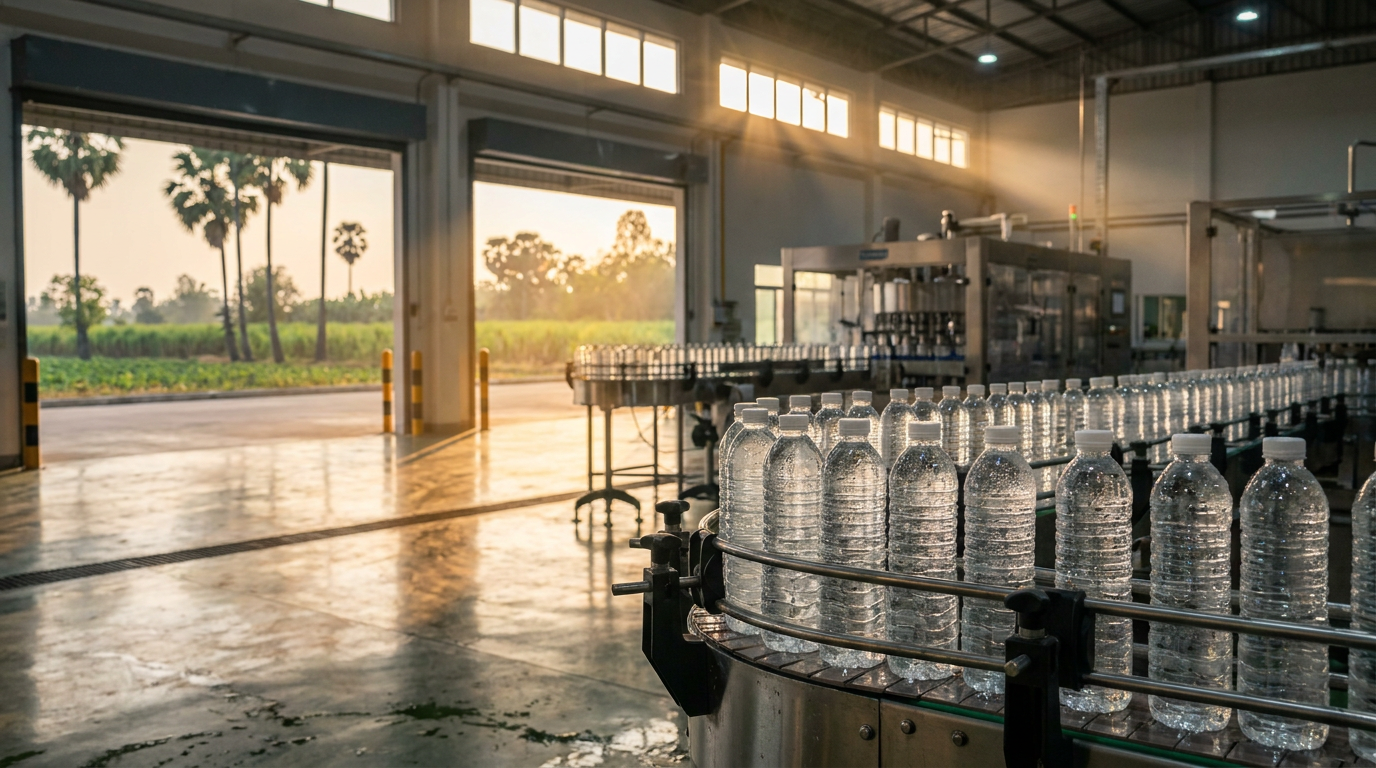
The story got filed as a food group expanding into drinking water. I read it as a published price list. A Thai stock exchange filing has now put a number on a water plant.
Charoen Pokphand Foods is taking 51% of Brew Factory, a Thai bottled and mineral water producer. The price is THB 334.7 million, about $10.1 million. The company was founded in December 2025. It runs one site in Surin Province, Thailand. The site holds a factory, a warehouse and an office. Capacity is 295 million litres a year.
Two tranches, and only one of them is a purchase
The filing splits the money in two. On 1 September the buyer took 436,240 existing shares, or 43.6%, from the current owners. That cost THB 235.3 million. Within thirty days the company issues 216,940 new shares. The buyer subscribes for 184,400 of them. That costs a further THB 99.4 million.
Only the first tranche is a purchase. The second is funding. THB 235.3 million went to shareholders. THB 99.4 million goes into the company's own account as fresh equity.
That changes the valuation. Price the business off the purchase tranche and it is worth about THB 540 million. Call it $16.3 million. Price it off the headline and you get THB 656 million instead. The headline overstates what the business was worth before the buyer arrived by about a fifth.
Fifteen times earnings, nine months after incorporation
The filing also carries trading figures. For the five months to the end of May, revenue was THB 210 million. Net profit was THB 15 million. Annualise that roughly and you get around THB 500 million of revenue and THB 36 million of profit. A five-month stub from a new company gives you a direction. Treat the annual figure as an estimate.
Now set the pre-money value against it. The buyer is paying close to fifteen times net profit here. The company did not exist a year ago.
That number should stop a dispense operator mid-sentence. A water cooler business is normally sold on one idea. Its value sits in a customer book nobody can rebuild fast. Brew Factory has no such book. It has a plant and an order sheet, and nine months of history. A listed giant still paid a serious multiple for it.
Nobody in this deal bought a brand
Most of Brew Factory's revenue comes from contract manufacturing. It fills bottles carrying other people's labels. Its own water brand, Sabai, is the smaller part. The buyer paid for the ability to fill bottles, and the customer relationships sit with the filling line.
There is a European parallel. Nestle Waters has held about 60% of Erikli in Turkey since 2006. That is control, with the founders left holding a real stake. The Thai deal has the same shape. Neither buyer wanted the whole company.
Zenith models Turkey, and it is the most fragmented large bottled market we cover. Hundreds of licensed regional producers sit behind a handful of national brands. No single producer holds anything close to a commanding share of production. A market shaped like that is really a list of targets. A published price becomes the opening bid on every one.
The assets a food group will actually recognise
Here the bottled side has an advantage that never shows up in its own pitch. A filling line, a cold store, a van fleet and a water licence are all sellable outside dispense. Charoen Pokphand Foods is a poultry and food conglomerate, and it has just bought a water plant. Food groups and drinks bottlers understand those assets already.
A mains-fed estate works differently. Point of use, the plumbed-in format, puts a few thousand machines inside other people's buildings. That estate has one natural buyer, which is another dispense operator. ITS estates are narrower again. That is the counter tap pouring boiling and sparkling water. Operators running bottled water dispense hold a wider exit than they think. Nobody has ever put a price on it.
Three numbers to have ready before a buyer asks
Every operator should be able to answer three questions in one line each. What would it cost to replace my physical assets today? What is my profit, stated the way a filing would state it? And who outside this industry could use what I own?
Charoen Pokphand Foods has just answered all three for a water plant, in public, with a regulator watching. Very few operators in this sector could answer all three. Expect the next wave of buyers to come from outside the sector. Food and drinks groups want filling capacity and route density. The operators who get paid properly will show what they own. They will show it in numbers a stranger can check.
🌍 Which markets do we actually cover?
Water Dispense Insights carries the whole picture across Europe and beyond. Market size, the operators trading in each country, channel mix and where the numbers are heading.
P.S. A plant or a customer book in another country may land on your desk this quarter. You will want the local numbers before you answer. The 2026 Zenith Water Dispense Market Reports cover more than 30 markets. Europe is complete, west and east. Five markets outside it come on request: South Korea, Mexico, UAE, Turkey and Japan. Each report builds the three dispense formats from unit level up. You get who trades there and what each one holds. Domestic and B2B volumes are split out, and revenue runs through to 2030. Ask for the written report and it comes alongside the Excel. Trusted by industry leaders since 1998. See the 2026 reports.