A UK food site cut its mains water by half. The POU water cooler market has been selling the wrong number
By Zenith Water Dispense Team ·
A single UK warehouse saved 2.5 million litres of mains water in a year. That is the annual pour of a few thousand water coolers.
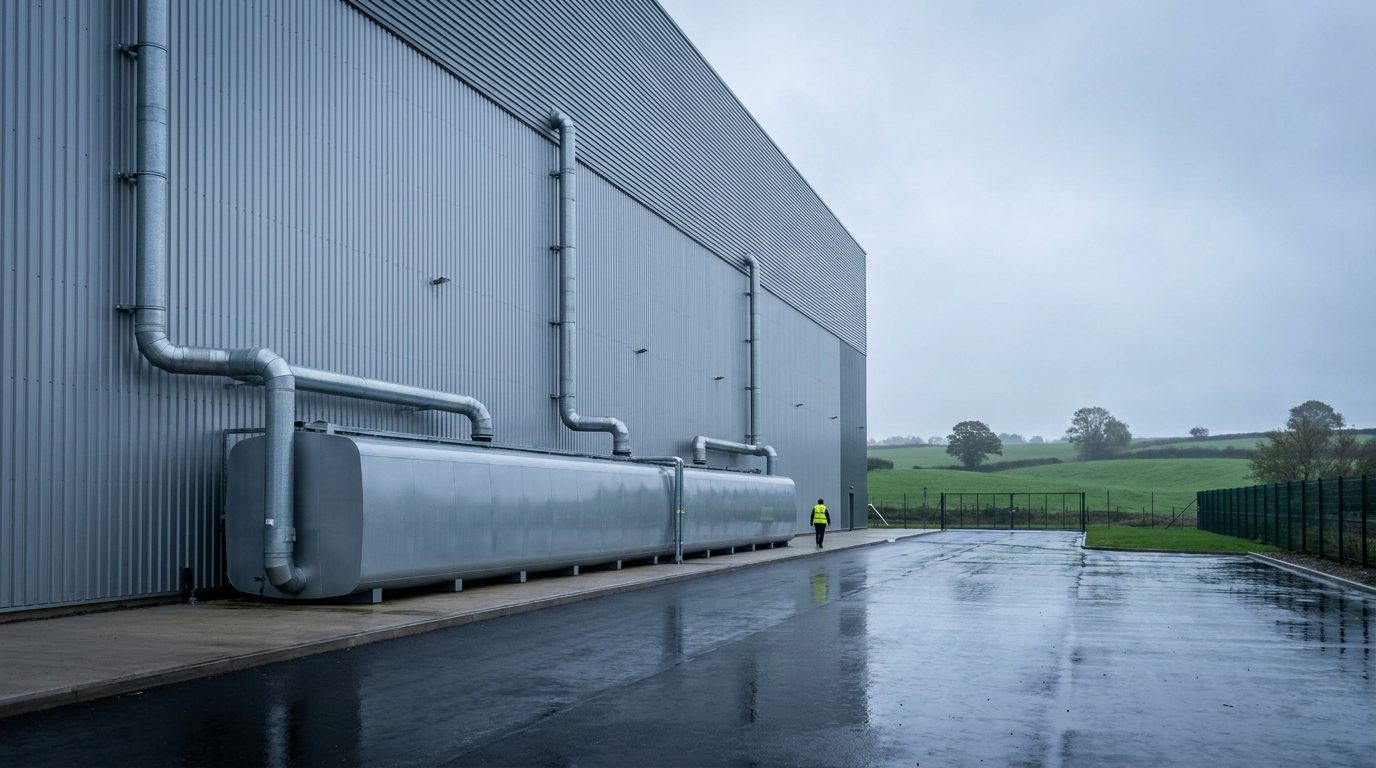
Here is the question I keep putting to operators. Can you tell me what one machine of yours pours over twelve months? Hardly any of them can answer it. This week pladis said one of its UK logistics sites had cut mains water use by half. The saving came to 2.5 million litres over the past year.
What that saving looks like in machines
pladis makes McVitie's and Jacob's. The site is a distribution centre at Ashby-de-la-Zouch in Leicestershire. A rainwater system feeds the non-drinking uses there, including the toilets. The company has put a five-figure sum into extending it to a second centre. It expects a further 25% cut in water use at that one.
Now convert the figure. A bottled machine pours under a cubic metre of water a year. That holds in about three quarters of the European markets we model. Bottled water dispense, labelled BWD in the trade, runs on 19 litre bottles carried in by van. One warehouse's annual saving is therefore worth the yearly pour of a few thousand bottled coolers. The water a dispense fleet moves is small enough to vanish on a client's own meter.
The water claim was always the weak one
That arithmetic cuts both ways. Mains-fed point of use coolers, the ones the trade tags POU, draw from the building's own supply. Their volume lands on the client's meter, and it is tiny. A format that barely registers on a site's water bill cannot win a tender on water saving.
Buyers in food and drink now run water programmes with budgets, targets and staff behind them. At Ashby the work was led by an employee group set up for exactly this. They will ask a supplier for a number, and they will check it. An operator who cannot state its own litres has nothing to bring to that table.
The volume line nobody publishes
There is a structural reason for the silence. Bottled volume is countable, because someone loaded the bottles on a van and billed for them. Mains-fed pour is not billed, so most operators never meter it. Connected machines can count every litre, and a growing share of the installed base now does. That data sits in a dashboard and almost never reaches a tender document.
Bottled water never reaches the customer's meter
Bottled has an advantage here that almost nobody argues. A delivered bottle is filled at a plant somewhere else. None of a bottled fleet's volume shows up on the customer's water bill or its discharge charge. In a building measured on mains draw, bottled adds nothing to the figure under pressure. That counts for most where water is metered hard, in food plants and laundries.
The move to mains-fed is still real and still running. Plumbed machines take out the van and the storage space. Neither reason has much to do with litres. The point here is narrower. A format cannot claim a saving on a line it barely touches.
Two measurable lines for the tender
Two lines, and both can be measured. The first is pour volume per machine per year, measured on the client's own sites. The second is the packaging and the delivery miles behind that volume. Packaging and transport are where a dispense format really moves a client's footprint. An auditor can check both. Instant taps and sparkling units, grouped as ITS, can put a gas cylinder route back on the road. So the second line does not shrink on its own.
Where this leaves buyers and investors
Water is turning into a measured input at site level across food and drink. Companies are now spending capital to bring their own draw down. Any supplier selling into those buildings will be asked for a volume figure. Whoever holds a modelled number answers first.
The investor question sits one step back. A book of accounts in water-metered sectors has a defensible story on packaging. On water the story is thin. Price the measurement capability, because a claim nobody can audit gets discounted in the room.
🌍 Where all of this coverage lives
Every market, format and data series Zenith publishes sits on one site. Have a look at what is already tracked before you commission anything new.
P.S. A claim you cannot measure is a claim a procurement team will discount. Pour volume and installed base are modelled separately for every market. Each of the 2026 Zenith Water Dispense Market Reports carries both figures. A European project can draw on thirty-one separate market models. Beyond Europe, the UAE, South Korea, Japan, Turkey and Mexico are modelled too. Analysts tend to live in the figures. The reasoning is there for whoever has to present it. Built from direct interviews with local operators and data partnerships in every market we cover. Put numbers behind the claim.